Step 03 - Voting, Loops, and Adaptive Model Selection
In Step 2, we added guardrails to add some hard rules around agent outputs and tool inputs, so that a traveler on a tight budget cannot create a trip with a fancy Lamborghini, or a group of 10 gets stuck in a small Fiat 500. Those are pretty clear cut rules, but what if a family of four books five days on the Italian Riviera with a moderate budget, and the vehicle agent recommends a compact hatchback. The guardrails from Step 02 let it through, because it seats four, and it isn’t a Ferrari.
While technically possible, it’s questionable whether four people and their luggage will be comfortable in it for five days, or it’s good value for their budget, or efficient it is on the coast roads. A recommendation that passes the rules isn’t necessarily the best one, and the Miles of Smiles customer reviews are starting to say so.
In this step we’ll give the planner a small review panel. Three evaluator agents each score the vehicle recommendation, a voting pattern combines their scores, and a refinement loop lets a reviser agent improve the recommendation until the panel is satisfied. We’ll also add adaptive model selection, so the reviser switches to a more capable model for the final polish once the recommendation is nearly there.
Parallel assessment with the voting pattern
The voting pattern sends the same question to several agents in parallel and collects their answers. The difference from a plain parallel workflow is the last step, where a voting strategy combines the answers into one decision. It could average the scores, take a majority, or apply whatever logic you like.
Voting spreads the judgement across agents that each have one narrow job. An agent that only thinks about cost will catch cost problems that a general-purpose evaluator might ignore. Each agent’s score is also visible on its own, so you can see exactly who voted for or against a decision.
For the family planning the Italian Riviera trip, a comfort evaluator could look at space for four people and their bags, a cost evaluator at the moderate budget, and a fuel efficiency evaluator at consumption and range over five days of driving.
flowchart LR
    accTitle: Voting pattern with three evaluators
    accDescr: The vehicle recommendation is sent to three evaluators in parallel. Each returns a score and suggestions. A voting strategy aggregates the scores into a single evaluation.
    Vehicle[Vehicle recommendation] --> E1[Comfort evaluator]
    Vehicle --> E2[Cost evaluator]
    Vehicle --> E3[Fuel efficiency evaluator]
    E1 -->|score + suggestions| Agg[Voting strategy]
    E2 -->|score + suggestions| Agg
    E3 -->|score + suggestions| Agg
    Agg --> Result[Aggregated evaluation]

    classDef evaluator fill:#e3f2fd,stroke:#1565c0,color:#0d3b66
    classDef strategy fill:#fff3e0,stroke:#b56500,color:#593200
    class E1,E2,E3 evaluator
class Agg strategyWe’ll implement this new feature with the VotingPlanner provided by the LangChain4j agentic patterns module. This planner pattern starts all evaluator subagents in parallel and records each result as a vote when the evaluator completes. Once every evaluator has reported, it passes the votes to a VotingStrategy for aggregation.
Iterative refinement with @LoopAgent
A single round of voting tells us how good the recommendation is, but it doesn’t make it any better. For that we need a loop. After the evaluators vote and the score is too low, a reviser agent will improve the recommendation and then the evaluators vote again. As you can imagine, it’s important to make sure the vote is a numeric value, and to include an exit condition to close the loop.
flowchart TD
    accTitle: Vehicle review loop
    accDescr: The evaluators vote on the vehicle from the research phase. If the average score reaches 7.5, the loop exits and the vehicle goes to cost estimation. Otherwise the reviser improves the recommendation and the evaluators vote again. If the score is still too low after three revisions, the request fails with quality_not_met.
    Start[Vehicle from research phase] --> Eval[VehicleEvaluators vote]
    Eval --> Check{Average score ≥ 7.5?}
    Check -->|Yes| Cost[CostEstimatorAgent]
    Check -->|No, revisions left| Revise[VehicleReviser improves the vehicle]
    Revise --> Eval
    Check -->|No, 3 revisions used| Fail[quality_not_met error]

    classDef loop fill:#e8f5e9,stroke:#2e7d32,color:#16351a
    classDef check fill:#fff3e0,stroke:#b56500,color:#593200
    classDef fail fill:#ffebee,stroke:#c62828,color:#5f1111
    class Eval,Revise loop
    class Check check
class Fail failThe @LoopAgent annotation turns this cycle into an agent with a maximum number of iterations, and an @ExitCondition method decides when to stop.
For our family, the reviser might swap the compact hatchback for an estate with room for the luggage, and the panel votes again. If the reviser has had three attempts and the evaluators still aren’t convinced, the loop gives up and the planner returns a quality_not_met error. Miles of Smiles would rather tell the family it couldn’t find a car it’s proud of than hand them the keys to a cramped one.
Adaptive model selection with @ChatModelSupplier
When building agentic applications, it’s important to choose the right model for the job. Some models are really good at certain tasks, while others are better at other tasks. We also have to consider the cost of models. The latest frontier models might be generally more capable, but they’re typically also quite a bit more expensive. If you’ve gone through Section 2 Step 07, you have already seen how different agents can use different models to optimize capability and cost usage.
In this case, Miles of Smiles wants the final reviser that reviews the votes and the specific suggestions from the evaluators to use a more capable model when the combined score is close to the theshold so that it can make the best decision possible:
| Evaluation score | Model selected | Rationale |
|---|---|---|
| ≤ 6.0 | base model | Broad changes still needed, such as a bigger car or a different category |
| > 6.0 | enhanced model | Detailed polishing against several evaluators’ suggestions at once |
Preparing the working copy
As always, you can keep building on the previous step or read along with the finished solution.
Keep working in your Step 02 working copy and apply the changes below. If you get stuck, compare your code with section-3/step-03.
Copy section-3/step-03 to a working directory and open that copy. It already contains the changes below, so you can follow along through the implementation, then join the exercise at Testing the voting loop.
Add the vehicle evaluation model
The evaluator agents need a shared return type to represent their assessment.
Create src/main/java/com/tripplanner/model/VehicleEvaluation.java:
package com.tripplanner.model;

public record VehicleEvaluation(
        double score,
        String suggestions
) {}
Each evaluator will return a score between 1 and 10, along with textual suggestions for improvement. The voting strategy will average the scores and concatenate the suggestions.
Create the evaluator agents
Each evaluator is a simple agent that cares about exactly one thing: comfort, cost, or fuel efficiency.
Create src/main/java/com/tripplanner/agentic/agents/ComfortEvaluator.java:
package com.tripplanner.agentic.agents;

import com.tripplanner.model.TripPlan;
import com.tripplanner.model.VehicleEvaluation;
import dev.langchain4j.agentic.Agent;
import dev.langchain4j.service.UserMessage;

public interface ComfortEvaluator {

    @UserMessage("""
            You are a comfort evaluator for road trip vehicles.
            Rate the vehicle recommendation on a scale of 1-10 for passenger comfort,
            considering interior space, luggage capacity, ride quality, and suitability
            for the number of travelers and trip type.

            Vehicle: {vehicle}
            Trip type: {tripType}
            Number of travelers: {travelers}
            Duration: {days} days
            """)
    @Agent(description = "Evaluates vehicle comfort, space, and luggage capacity",
           outputKey = "comfortEval")
    VehicleEvaluation evaluateComfort(TripPlan.VehicleRecommendation vehicle,
                                      String tripType,
                                      String travelers,
                                      String days);
}
Create src/main/java/com/tripplanner/agentic/agents/CostEvaluator.java:
package com.tripplanner.agentic.agents;

import com.tripplanner.model.TripPlan;
import com.tripplanner.model.VehicleEvaluation;
import dev.langchain4j.agentic.Agent;
import dev.langchain4j.service.UserMessage;

public interface CostEvaluator {

    @UserMessage("""
            You are a cost evaluator for road trip vehicles.
            Rate the vehicle recommendation on a scale of 1-10 for cost efficiency,
            considering rental price relative to budget, fuel economy, and overall
            value for money for the trip duration.

            Vehicle: {vehicle}
            Budget: {budget}
            Number of travelers: {travelers}
            Duration: {days} days
            """)
    @Agent(description = "Evaluates vehicle rental cost and budget fit",
           outputKey = "costEval")
    VehicleEvaluation evaluateCost(TripPlan.VehicleRecommendation vehicle,
                                   String budget,
                                   String travelers,
                                   String days);
}
Create src/main/java/com/tripplanner/agentic/agents/FuelEfficiencyEvaluator.java:
package com.tripplanner.agentic.agents;

import com.tripplanner.model.TripPlan;
import com.tripplanner.model.VehicleEvaluation;
import dev.langchain4j.agentic.Agent;
import dev.langchain4j.service.UserMessage;

public interface FuelEfficiencyEvaluator {

    @UserMessage("""
            You are a fuel efficiency evaluator for road trip vehicles.
            Rate the vehicle recommendation on a scale of 1-10 for fuel efficiency,
            considering fuel consumption, driving range, and environmental impact
            for the planned trip duration and destination.

            Vehicle: {vehicle}
            Destination: {destination}
            Duration: {days} days
            Trip type: {tripType}
            """)
    @Agent(description = "Evaluates vehicle fuel consumption, range, and environmental impact",
           outputKey = "fuelEval")
    VehicleEvaluation evaluateFuelEfficiency(TripPlan.VehicleRecommendation vehicle,
                                             String destination,
                                             String days,
                                             String tripType);
}
- Each evaluator uses
@Agentwith a uniqueoutputKey, so its individual score remains in the workflow scope next to the aggregated result. - The evaluators take the current
vehiclerecommendation from the scope, plus trip context parameters for their specific assessment dimension. - All three return
VehicleEvaluation, the same record type, so the aggregation strategy can process them uniformly.
Add the voting planner
LangChain4j provides ready-made planners for common orchestration patterns in its langchain4j-agentic-patterns module, and its VotingPlanner does exactly what the evaluators need. The Quarkus LangChain4j BOM already manages the module’s version, so the dependency does not need a <version> element.
Add the agentic patterns dependency to pom.xml:
<dependency>
    <groupId>dev.langchain4j</groupId>
    <artifactId>langchain4j-agentic-patterns</artifactId>
</dependency>
The planner only coordinates the evaluators, while the decision about how to combine their votes comes from a VotingStrategy. This is a functional interface that receives the collected votes and returns the aggregate, so any lambda or method reference can act as a strategy.
The library includes majority(), average(), and highest() strategies for votes that are plain values such as labels or numbers. Our evaluators return a VehicleEvaluation that combines a score with suggestions, so we’ll write our own strategy that averages the scores and keeps every evaluator’s suggestions for the reviser.
Wire evaluators with @PlannerAgent
The @PlannerAgent annotation connects the evaluator subagents to the voting planner through a @PlannerSupplier method.
Create src/main/java/com/tripplanner/agentic/workflow/VehicleEvaluators.java:
package com.tripplanner.agentic.workflow;

import com.tripplanner.agentic.agents.ComfortEvaluator;
import com.tripplanner.agentic.agents.CostEvaluator;
import com.tripplanner.agentic.agents.FuelEfficiencyEvaluator;
import com.tripplanner.model.VehicleEvaluation;
import dev.langchain4j.agentic.declarative.PlannerAgent;
import dev.langchain4j.agentic.declarative.PlannerSupplier;
import dev.langchain4j.agentic.patterns.voting.VotingPlanner;
import dev.langchain4j.agentic.planner.Planner;

import java.util.Collection;
import java.util.List;
import java.util.stream.Collectors;

public interface VehicleEvaluators {

    @PlannerAgent(
            name = "vehicleEvaluators",
            description = "Dispatches evaluators in parallel and aggregates their votes",
            outputKey = "evaluation",
            subAgents = {
                    ComfortEvaluator.class,
                    CostEvaluator.class,
                    FuelEfficiencyEvaluator.class
            })
    VehicleEvaluation evaluate(String destination,
                               String tripType,
                               String travelers,
                               String days,
                               String budget);

    @PlannerSupplier
    static Planner planner() {
        return new VotingPlanner(VehicleEvaluators::aggregateVotes);
    }

    static Object aggregateVotes(Collection<Object> votes) {
        if (votes == null || votes.size() != 3) {
            throw new IllegalStateException("Expected all three vehicle evaluations");
        }
        List<VehicleEvaluation> evaluations = votes.stream().map(VehicleEvaluators::checkedEvaluation).toList();
        double average = evaluations.stream().mapToDouble(VehicleEvaluation::score).average().orElseThrow();
        String suggestions = evaluations.stream()
                .map(VehicleEvaluation::suggestions)
                .filter(s -> s != null && !s.isBlank())
                .collect(Collectors.joining("; "));
        return new VehicleEvaluation(average, suggestions);
    }

    private static VehicleEvaluation checkedEvaluation(Object vote) {
        if (!(vote instanceof VehicleEvaluation eval) || !Double.isFinite(eval.score())
                || eval.score() < 1 || eval.score() > 10) {
            throw new IllegalStateException("Each vehicle evaluator must return a score between 1 and 10");
        }
        return eval;
    }
}
The class has three parts:
@PlannerAgentlists the three evaluators assubAgentsand stores the aggregated score underoutputKey = "evaluation", where the exit condition and the reviser can find it. Its method signature lists the trip details the evaluators need, and the framework passes them along through the workflow scope.@PlannerSupplierreturns a newVotingPlannerthat usesaggregateVotesas its voting strategy.aggregateVotesaverages the scores and collects the suggestions. It expects exactly threeVehicleEvaluationresults with scores between 1 and 10, and throwsIllegalStateExceptionif one is missing or malformed.
How does the VotingPlanner drive the evaluators?
A planner decides which subagents run next each time the framework asks it for an action. The VotingPlanner answers the first request with call(subagents), which starts all evaluators in parallel. The framework then asks for the next action once for every evaluator that completes. The planner adds that evaluator’s output to its votes and returns noOp() while others are still running. After the last one reports, it returns done(...) with the strategy’s result, which becomes the output of VehicleEvaluators. Its topology() method returns PARALLEL, so the Dev UI renders the evaluators as parallel branches.
The framework calls the @PlannerSupplier method on every invocation, so each loop iteration collects its votes in a new planner. The VotingPlanner source is a compact example of the Planner interface if you want to write a planner of your own.
Add the vehicle reviser with @ChatModelSupplier
The reviser agent takes the current recommendation and evaluation feedback and produces an improved recommendation. It uses adaptive model selection to pick the right model for the current quality level.
Create src/main/java/com/tripplanner/agentic/agents/DynamicModelSelector.java:
package com.tripplanner.agentic.agents;

import com.tripplanner.model.VehicleEvaluation;
import dev.langchain4j.model.chat.ChatModel;
import io.quarkiverse.langchain4j.ModelName;
import io.quarkus.logging.Log;
import jakarta.inject.Inject;
import jakarta.inject.Singleton;

@Singleton
public class DynamicModelSelector {

    private static final double ENHANCED_MODEL_THRESHOLD = 6.0;

    @Inject
    ChatModel baseModel;

    @Inject
    @ModelName("enhancedModel")
    ChatModel enhancedModel;

    public ChatModel select(VehicleEvaluation evaluation) {
        if (evaluation != null && evaluation.score() > ENHANCED_MODEL_THRESHOLD) {
            Log.infof("Score %.1f > %.1f — switching to enhanced model for final refinement",
                    evaluation.score(), ENHANCED_MODEL_THRESHOLD);
            return enhancedModel;
        }
        return baseModel;
    }
}
Create src/main/java/com/tripplanner/agentic/agents/VehicleReviser.java:
package com.tripplanner.agentic.agents;

import com.tripplanner.model.TripPlan;
import com.tripplanner.guardrails.TripAppropriatenessGuardrail;
import dev.langchain4j.service.guardrail.OutputGuardrails;
import com.tripplanner.model.VehicleEvaluation;
import dev.langchain4j.agentic.Agent;
import dev.langchain4j.agentic.declarative.ChatModelSupplier;
import dev.langchain4j.model.chat.ChatModel;
import dev.langchain4j.service.UserMessage;
import io.quarkiverse.langchain4j.agentic.runtime.CdiBean;

public interface VehicleReviser {

    @UserMessage("""
            You are a vehicle recommendation specialist.
            Revise the current vehicle recommendation based on the evaluation feedback.
            Keep the same format but improve the choice to address the evaluators' suggestions.

            Current recommendation: {vehicle}
            Evaluation score: {evaluation}
            Trip type: {tripType}
            Number of travelers: {travelers}
            Budget: {budget}
            Destination: {destination}
            Additional preferences: {preferences}
            Preserve the original traveler, budget, and preference constraints.
            """)
    @OutputGuardrails(value = TripAppropriatenessGuardrail.class, maxRetries = 3)
    @Agent(description = "Revises the vehicle recommendation based on evaluation feedback",
           outputKey = "vehicle")
    TripPlan.VehicleRecommendation revise(TripPlan.VehicleRecommendation vehicle,
                                          VehicleEvaluation evaluation,
                                          String tripType,
                                          String travelers,
                                          String budget,
                                          String destination,
                                          String preferences);

    @ChatModelSupplier
    static ChatModel chatModel(@CdiBean DynamicModelSelector modelSelector,
                               VehicleEvaluation evaluation) {
        return modelSelector.select(evaluation);
    }
}
DynamicModelSelector is a @Singleton bean that injects both the default ChatModel and the @ModelName("enhancedModel") model, and picks one based on the current evaluation score.
In the reviser, two annotations are worth a closer look:
@OutputGuardrails(TripAppropriatenessGuardrail.class, maxRetries = 3)keeps the Step 02 content guardrail, so a revision that breaks the rules gets up to three more tries.outputKey = "vehicle"overwrites the vehicle in the scope, so the cost estimator and everything after it receive the refined version without extra wiring.
Wrap the review cycle with @LoopAgent
The loop wraps the evaluators and reviser into an iterative cycle with an exit condition.
Create src/main/java/com/tripplanner/agentic/workflow/VehicleReviewLoop.java:
package com.tripplanner.agentic.workflow;

import com.tripplanner.agentic.agents.VehicleReviser;
import com.tripplanner.model.TripPlan;
import com.tripplanner.model.VehicleEvaluation;
import com.tripplanner.model.TripQualityException;
import dev.langchain4j.agentic.scope.AgenticScope;
import dev.langchain4j.agentic.declarative.ExitCondition;
import dev.langchain4j.agentic.declarative.LoopAgent;

public interface VehicleReviewLoop {

    int MAX_REVISIONS = 3;

    @LoopAgent(
            name = "vehicleReviewLoop",
            description = "Iteratively evaluates and refines the vehicle recommendation",
            outputKey = "vehicle",
            // One initial evaluation plus an evaluation after each permitted revision.
            maxIterations = MAX_REVISIONS + 1,
            subAgents = {
                    VehicleEvaluators.class,
                    VehicleReviser.class
            })
    TripPlan.VehicleRecommendation reviewVehicle(String destination,
                                                  String startDate,
                                                  String days,
                                                  String tripType,
                                                  String travelers,
                                                  String budget,
                                                  String preferences);

    @ExitCondition(
            testExitAtLoopEnd = false,
            description = "Exits when the average evaluation score reaches 7.5")
    static boolean shouldExit(VehicleEvaluation evaluation, AgenticScope scope) {
        if (evaluation != null && evaluation.score() >= 7.5) return true;
        // Checked after evaluation, before another revision can leave an unscored candidate.
        if (scope.agentInvocations(VehicleEvaluators.class).size() > MAX_REVISIONS) throw new TripQualityException();
        return false;
    }
}
@LoopAgent runs VehicleEvaluators and then VehicleReviser on each iteration. With maxIterations = MAX_REVISIONS + 1 that makes four iterations: the first evaluation, plus one more after each of the three allowed revisions. The loop’s own outputKey = "vehicle" writes the final vehicle back to the scope, replacing the one from the research phase.
@ExitCondition(testExitAtLoopEnd = false) checks the condition right after each evaluation, before the reviser gets its turn. shouldExit receives the latest VehicleEvaluation and the AgenticScope, and ends up in one of three places:
- A score of 7.5 or more returns
trueand ends the loop. - A lower score with revisions left returns
false, and the reviser runs. - A lower score after
MAX_REVISIONSrevisions throwsTripQualityException, which reaches the browser as a 422 with error codequality_not_met.
Before the loop can throw TripQualityException, you need the exception class itself.
Create src/main/java/com/tripplanner/model/TripQualityException.java:
package com.tripplanner.model;

public class TripQualityException extends RuntimeException {
    public static final String CODE = "quality_not_met";
    public static final String MESSAGE = "The vehicle recommendation did not meet the quality threshold after three revisions. Please revise your trip details and try again.";

    public TripQualityException() {
        super(MESSAGE);
    }
}
The CODE and MESSAGE constants are used by the exception mapper and the frontend to display a consistent error when the loop exhausts its revision budget.
Update the main workflow
Open src/main/java/com/tripplanner/agentic/workflow/TripPlannerSystem.java and add VehicleReviewLoop.class to the subAgents array, between ResearchPhase and CostEstimatorAgent:
package com.tripplanner.agentic.workflow;

import com.tripplanner.agentic.agents.CostEstimatorAgent;
import com.tripplanner.model.ItineraryResult;
import com.tripplanner.model.TripPlan;
import dev.langchain4j.agentic.declarative.Output;
import dev.langchain4j.agentic.declarative.SequenceAgent;
import dev.langchain4j.agentic.observability.MonitoredAgent;

public interface TripPlannerSystem extends MonitoredAgent {

    @SequenceAgent(
            outputKey = "tripPlan",
            subAgents = {
                    ResearchPhase.class,
                    VehicleReviewLoop.class,
                    CostEstimatorAgent.class
            })
    TripPlan planTrip(String destination,
                      String startDate,
                      String days,
                      String tripType,
                      String travelers,
                      String budget,
                      String preferences);

    @Output
    static TripPlan output(TripPlan.VehicleRecommendation vehicle,
                           ItineraryResult itineraryResult,
                           TripPlan.CostEstimate costs) {
        return new TripPlan(
                vehicle,
                itineraryResult.routeOverview(),
                itineraryResult.itinerary(),
                costs);
    }
}
The sequence now runs: parallel research → voting evaluation loop → cost estimation. The @Output method is unchanged because it still assembles the final TripPlan from vehicle, itineraryResult, and costs. The loop simply refines which vehicle reaches the cost estimator.
Configure adaptive model selection
Update src/main/resources/application.properties to add the enhanced model configuration:
# LLM Configuration (base model)
quarkus.langchain4j.openai.api-key=${OPENAI_API_KEY}
quarkus.langchain4j.openai.chat-model.model-name=gpt-4o
quarkus.langchain4j.openai.chat-model.temperature=0.7
quarkus.langchain4j.openai.timeout=120

# Enhanced model for adaptive selection (vehicle refinement)
quarkus.langchain4j.enhancedModel.chat-model.provider=openai
quarkus.langchain4j.openai.enhancedModel.api-key=${OPENAI_API_KEY}
quarkus.langchain4j.openai.enhancedModel.chat-model.model-name=gpt-4.1
quarkus.langchain4j.openai.enhancedModel.chat-model.temperature=0.7
quarkus.langchain4j.openai.enhancedModel.timeout=120

# Skills configuration
quarkus.langchain4j.skills.directories=classpath:skills
%dev.quarkus.live-reload.watched-resources=skills/family-trip/SKILL.md
- The base model stays
gpt-4o, which every other agent keeps using. - The
enhancedModelis configured as a separate named model usinggpt-4.1. The@ModelName("enhancedModel")qualifier inDynamicModelSelectorresolves to this configuration. - Both models share the same
OPENAI_API_KEY. The enhanced model has its own temperature and timeout settings.
Testing the voting loop
Time to put the Riviera family’s trip in front of the review panel! If the application is not already running, start it from the project directory you chose above:
Open http://localhost:8080 and fill in the form:
- Destination:
Italian Riviera - Start date: a future date
- Duration:
5days - Travelers:
4 - Trip Type:
Family Vacation - Budget:
Moderate (€1,000–€2,500)
Click Generate Trip Plan, wait for it to finish, and look for the evaluation and model selection messages in the terminal. You should see lines like:
This line means the DynamicModelSelector handed the revision to the enhanced model. It only appears when the reviser actually runs with a score above 6.0. If the evaluators liked the first vehicle enough to pass it outright, there’s nothing to revise and nothing to log, so try another run or two.
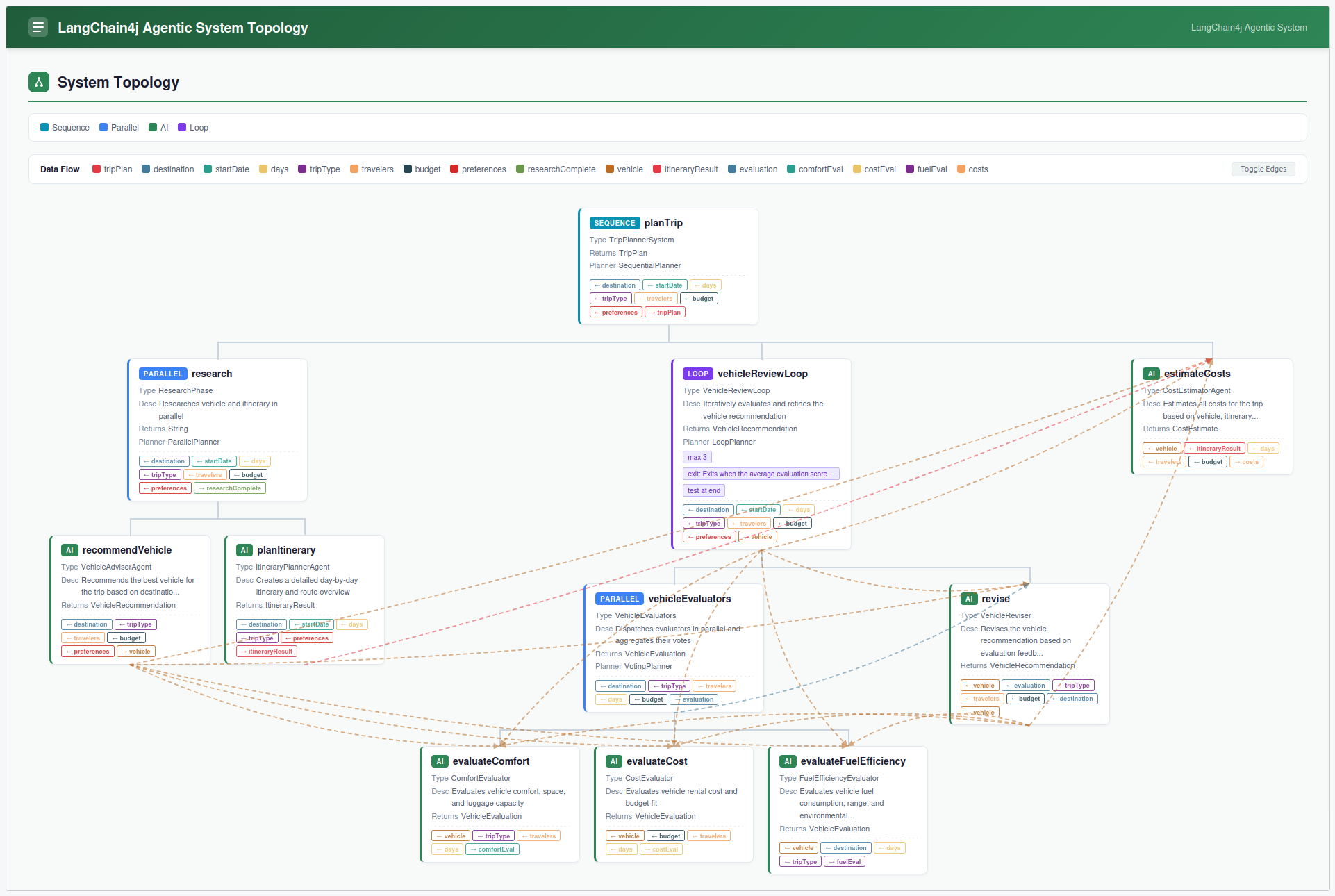
Open the Quarkus Dev UI and select Topology on the LangChain4j Agentic card. The graph shows the full agent structure: the planTrip sequence contains the parallel research phase, the vehicleReviewLoop, and estimateCosts. Inside the loop you can see the vehicleEvaluators node, rendered as a parallel fan-out with the three evaluators, and the vehicleReviser.
Switch to Executions on the same card and expand the latest run. Each agent has its own row with its duration, inputs, and outputs. Under vehicleReviewLoop, the vehicleEvaluators rows show the three individual scores and the average they produced. If the average reached 7.5 on the first vote, the loop ends right there and revise never runs. If it fell short, you’ll see a revise row followed by another round of evaluations, each tagged with its iteration number. Run the same request a few times and the number of rounds will probably change, because the evaluators are language models and have their moods like the rest of us.
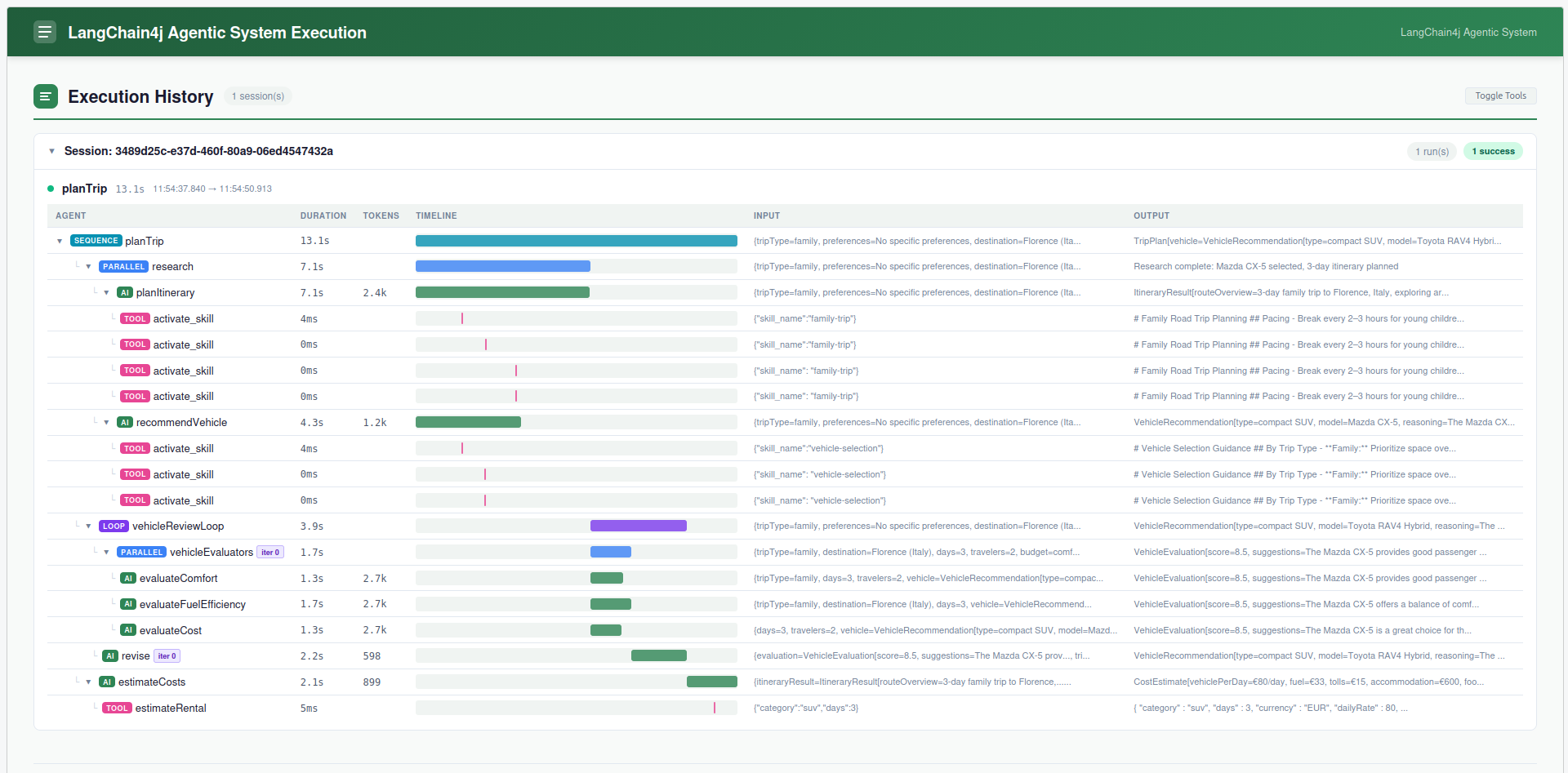
Now and then planItinerary also tries to activate a skill that doesn’t exist, such as route-overview. Those calls show up marked failed, the tool replies with the list of available skills, and the agent carries on with the one it did load.
Compare the output of recommendVehicle in the research phase with the output of vehicleReviewLoop. If the reviser ran, the two recommendations differ. If the first candidate passed, they’re the same vehicle.
Verifying with tests
The supplied tests verify the voting aggregation, pipeline assembly, and end-to-end HTTP contract without calling a live model.
Run the Step 03 test suite:
-
VehicleEvaluationAggregatorTestchecks the averaging strategy. Three scores produce the right average, blank suggestions are skipped, and a missing, incomplete, or out-of-range set of votes throwsIllegalStateException. -
TripPlanContractTestchecks thatVehicleReviewLoopsits betweenResearchPhaseandCostEstimatorAgentin the workflow, and that the trip plan JSON still has notipsfield. -
VehicleReviewWorkflowTestcalls the/trip/planendpoint with a scripted model. It covers a first candidate that passes outright, a low-scoring candidate that gets revised and re-evaluated, three failed revisions ending inquality_not_met, and the guardrail rejecting a revised recommendation, including the case where the guardrail runs out of retries. Each scripted profile also replaces the@ModelName("enhancedModel")model with an@Alternative, so theDynamicModelSelectorworks without a live API key.
Taking it further
-
As an optional exercise, try adding a fourth evaluator that assesses the vehicle’s suitability for the planned route terrain (mountain roads, coastal highways, city driving). Use a different
outputKeyand update theaggregateVotesmethod to handle four votes. -
You can also play with the exit threshold. Lowering it to 6.0 makes the loop exit sooner. Raising it to 9.5 will probably use up all three revisions, even though the scores tend to creep up with each one, and the browser then shows the
quality_not_metmessage. Add a log line insideshouldExitto watch the score change from one round to the next.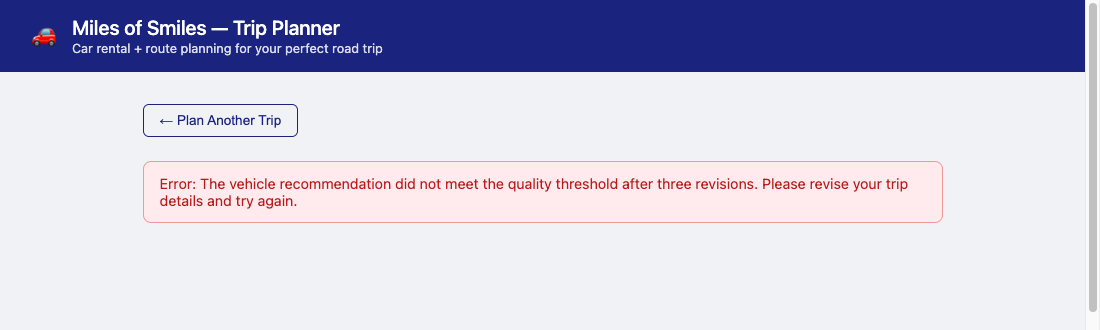
-
For a more advanced experiment, try a weighted voting strategy where the comfort evaluator counts double for family trips and the cost evaluator counts double for economy budgets. Pass the trip type into the aggregation to select the weights.
What’s next?
The planner now has a panel of evaluators that vote on every vehicle and a reviser that keeps trying until they’re happy. In Step 04, we’ll wrap the planning pipeline in an event-driven Quarkus Flow workflow, so the customer can take their time before approving or rejecting a trip.
Continue to Step 04 - Event-Driven Agentic Workflows with Quarkus Flow
Troubleshooting
The enhanced model is not configured
Check that application.properties has the quarkus.langchain4j.enhancedModel.* properties and that OPENAI_API_KEY is set. Both the base and enhanced models use the same API key. If the enhanced model configuration is missing, the @ModelName("enhancedModel") injection will fail at startup.
Every request ends with quality_not_met
Check the evaluator prompts and the exit condition threshold. If the evaluators consistently return low scores, three revisions may not be enough to get the recommendation over the line. Try lowering the threshold in VehicleReviewLoop.shouldExit() or adjusting the evaluator prompts to be more generous. Inspect the evaluation scores in the Dev UI execution view.
Tests fail with missing enhancedModel bean
Check that each test profile’s getEnabledAlternatives() includes both ScriptedModel.class and ScriptedEnhancedModel.class. The ScriptedEnhancedModel is an @Alternative @ModelName("enhancedModel") bean that delegates to the default scripted model.
OPENAI_API_KEY is not set
Set OPENAI_API_KEY in the shell used to start the application, then restart it. Both models require the same key.