Break your dependencies on purpose: introducing Quarkus Resiliency Testing

Imagine a customer placing an order. Your service reserves stock, charges their card, and stores the result. On a normal day, each step takes milliseconds and the customer sees a confirmation.
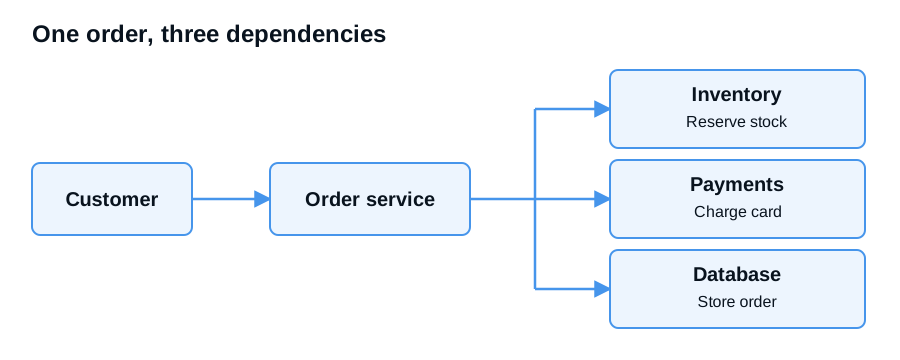
Now imagine inventory accepts the connection but never answers. Or the payment provider charges the card just before the connection breaks. Or the database stops responding while your application is holding a connection from its pool.
These failures demand different responses. Waiting longer can use up your workers; retrying can charge the customer twice; catching an exception does nothing if the client never throws one. A happy-path test tells you little about any of them.
Quarkus Resiliency Testing lets you reproduce these conditions in a @QuarkusTest, using your application’s real clients and configuration.
Let’s follow that order through four failure scenarios and turn each one into a test.
The examples are excerpts from the resilient-orders sample, which includes the endpoints, supporting classes and complete tests.
Put the failure on the wire
Add the test dependency:
<dependency>
    <groupId>io.quarkiverse.resiliencytesting</groupId>
    <artifactId>quarkus-resiliency-testing-junit</artifactId>
    <version>0.6.0</version>
    <scope>test</scope>
</dependency>
With NetworkFaultsProfile, the extension discovers supported outbound connections from Quarkus configuration, including Dev Services, and redirects them through proxies inside the test JVM.
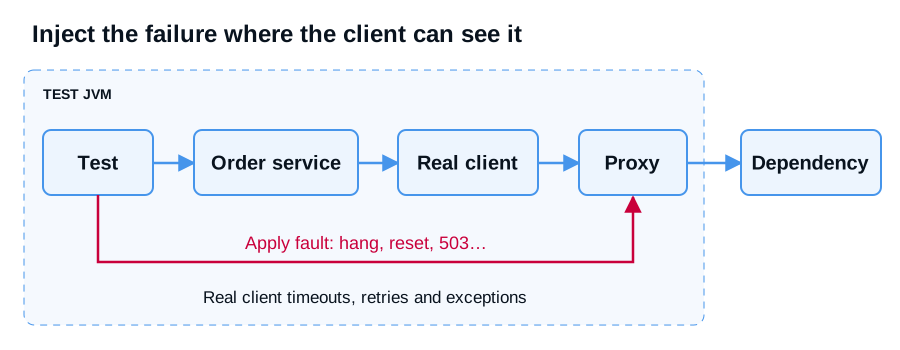
The proxy normally relays traffic. During a fault, the real client encounters the broken connection and reacts with its own timeouts, retries and exceptions. A mock that throws an exception can check a fallback; this also exercises the client configuration that determines whether, and when, that fallback is reached. The fault injection needs no separate container or sidecar; dependencies such as the sample’s PostgreSQL Dev Service can still need Docker.
1. Inventory stops answering
The customer clicks “Place order”, but inventory never responds.
We want to accept the order as pending instead of leaving the customer waiting indefinitely.
In this sample, Reservation.pending tells the endpoint to return 202 with status PENDING; completing the reservation later is a separate application responsibility.
@Timeout(2000) (1)
@CircuitBreaker(requestVolumeThreshold = 2, failureRatio = 1.0) (2)
@Bulkhead(2) (3)
@Fallback(fallbackMethod = "reserveLater") (4)
public Reservation reserve(String item) {
    return inventory.reserve(item);
}

Reservation reserveLater(String item) {
    return Reservation.pending(item);
}| 1 | The inventory service gets two seconds to answer. |
| 2 | Two failures in a row open the circuit breaker, and the inventory service is left alone for a while. |
| 3 | At most two calls wait on the inventory service at the same time; more on that below. |
| 4 | When the call fails, times out, or is refused by the open breaker or the full bulkhead, the order is accepted as pending instead. |
The test makes inventory hang, checks the pending response, then checks recovery:
@QuarkusTest
@TestProfile(NetworkFaultsProfile.class) (1)
class InventoryFailuresTest {

    @Inject
    Faults faults; (2)

    @Test
    void inventoryServiceHangs() {
        Target inventory = faults.target(InventoryClient.class); (3)
        try (var ignored = inventory.hangs()) { (4)
            when()
                    .post("/orders")
                    .then()
                    .statusCode(202) (5)
                    .body("status", is("PENDING"))
                    .time(lessThan(3000L));
        } (6)

        when()
                .post("/orders")
                .then()
                .statusCode(201) (7)
                .body("status", is("CONFIRMED"));
    }
}| 1 | Puts a proxy in front of supported outbound connections configured by the application. |
| 2 | The entry point for applying faults. |
| 3 | The dependency is named by the bean the application already injects, here the REST Client interface. |
| 4 | The fault is a single method call: from now on, the inventory service accepts connections and never answers. |
| 5 | The @Timeout fires, and the fallback accepts the order as pending. |
| 6 | The fault ends with the block: the dependency works again, connection pools are flushed and circuit breakers are reset. |
| 7 | So the recovery can be asserted in the same test: the next order is confirmed right away. |
The time assertion gives the two-second timeout some test overhead. Remove the timeout and a slower client timeout can no longer make the test pass merely by eventually reaching the fallback. The extension creates the failure; the application still has to handle it.
What happens to the next customer?
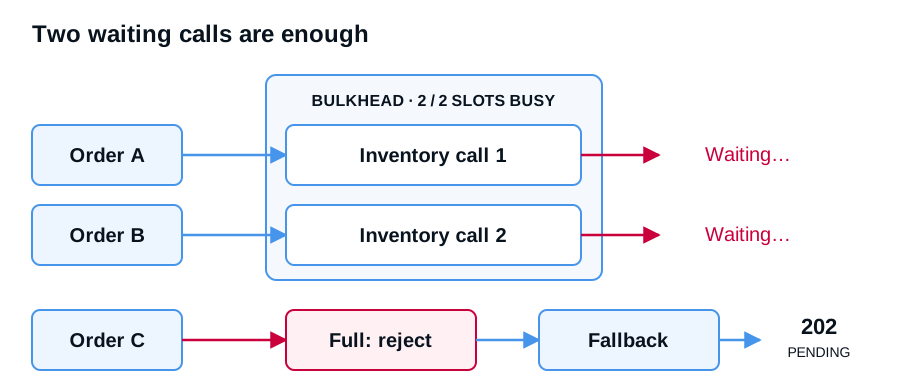
A timeout bounds one customer’s wait. It does not limit how many requests can be waiting at once. If orders keep arriving while inventory is hung, those calls can occupy the workers that other requests need.
The @Bulkhead(2) above limits concurrent calls to inventory to two.
The third call should take the fallback immediately:
Target inventory = faults.target(InventoryClient.class);
try (var callers = Executors.newFixedThreadPool(2);
        var ignored = inventory.hangs(Moment.onNextWrite())) { (1)
    for (int i = 0; i < 2; i++) {
        callers.submit(() -> when().post("/orders")); (2)
    }
    inventory.traffic()
            .awaitHeldConnections(2, Duration.ofSeconds(5)); (3)

    when()
            .post("/orders")
            .then()
            .statusCode(202)
            .time(lessThan(500L)); (4)
}| 1 | The inventory service stops answering a connection as soon as the application sends a request on it. |
| 2 | Two orders start, and wait on the inventory service: the bulkhead is full. |
| 3 | Waits until the proxy holds both requests, rather than for a fixed time, so the third request starts only after both calls are held. |
| 4 | The third order does not wait: the bulkhead rejects the call at once, and the fallback accepts the order as pending. |
Catches: the missing bulkhead: the third order waits for the full two-second timeout as well. Under real load, every one of those waits holds a worker thread.
2. The payment went through, but its answer did not
Inventory has recovered, and the customer pays. The payment provider records the charge and starts sending its response. Then the connection breaks. Our service sees a failure, but the money has already moved.
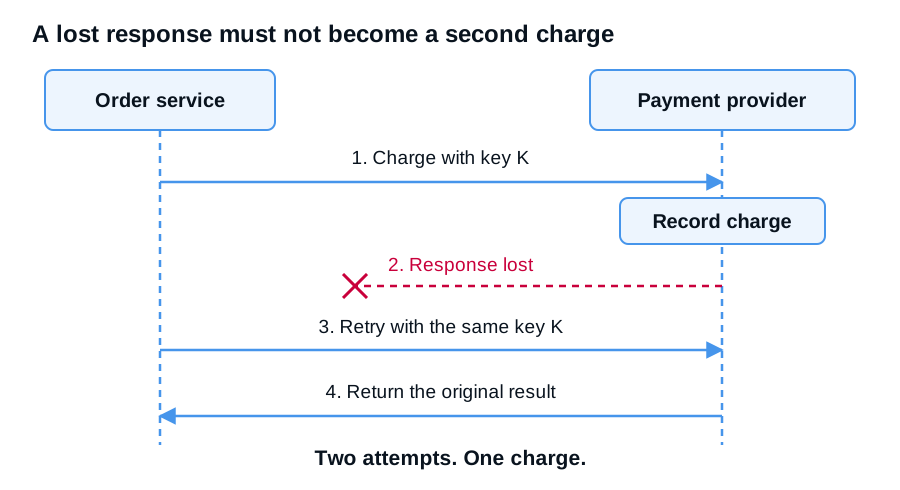
A retry can recover the request, provided the provider supports idempotency and every attempt carries the same key. Generate that key before entering the retried method:
// OrderResource
@POST
@Path("/{id}/payment")
public String pay(@PathParam("id") String id) {
    String idempotencyKey = UUID.randomUUID().toString(); (1)
    return payments.charge(idempotencyKey, id);
}

// PaymentService
@Retry(maxRetries = 2, delay = 200) (2)
public String charge(String idempotencyKey, String orderId) {
    return payments.charge(idempotencyKey, orderId);
}| 1 | One key per payment, generated before the first attempt. |
| 2 | Every attempt receives the same key, and sends it as the Idempotency-Key header. |
In the sample, a stand-in payment provider honours the keys like a real one, and records every charge, so the test can count them. The test loses the answer to the first payment, and checks what matters to the customer:
@Inject
PaymentLedger ledger; (1)

@Test
void responseLostAfterThePaymentWentThrough() {
    Target payments = faults.target(PaymentClient.class);
    try (var ignored = payments.http().forFirst(1)
            .diesMidRequest(Moment.Http.afterHeaders())) { (2)
        when()
                .post("/orders/42/payment")
                .then()
                .statusCode(200); (3)
    }

    var attempts = payments.traffic().httpRequests(); (4)
    assertEquals(2, attempts.size());
    assertEquals(200, attempts.get(0).responseStatus()); (5)
    assertEquals(1, ledger.chargesFor("42")); (6)
}| 1 | The charges recorded by the stand-in payment provider. |
| 2 | The first payment reaches the provider, which charges the card, but the connection dies right after the response headers: the application never sees the answer. |
| 3 | The @Retry sends the payment again, and the caller sees a success. |
| 4 | Every request that went through the proxy, with its headers and the status it was answered with. |
| 5 | The first attempt had succeeded: the retry came after a payment that went through. |
| 6 | The customer was charged once. |
Catches: the two classic mistakes. With the key generated inside the retried method, each attempt carries a different key, and the customer is charged twice. Without the retry, the card is charged but the customer is told the payment failed.
For retries of the incoming payment request itself, the key also needs to survive across requests; the example above covers retries within one request.
3. The database stops cooperating
A query that never returns
The customer now opens their order history.
The endpoint catches persistence failures and returns a 503 so the caller can try later:
@GET
public Response list() {
    try {
        return Response.ok(orderRepository.listAll()).build();
    } catch (PersistenceException e) {
        return Response.status(503).entity("orders unavailable").build();
    }
}
Here orderRepository is the sample’s injected Order.Repository; the extension resolves that repository to its datasource.
But a database that hangs does not necessarily produce an exception. The PostgreSQL JDBC driver waits forever for an answer by default, so the application needs a timeout of its own, or, as HikariCP’s Rapid Recovery guide puts it, "it is imperative that the application configures the driver-level TCP socket timeout":
quarkus.datasource.jdbc.additional-jdbc-properties.socketTimeout=3The test makes the database stop answering:
try (var ignored = faults.target(Order.Repository.class).hangs()) {
    when()
            .get("/orders")
            .then()
            .statusCode(503);
}
Catches: the missing socketTimeout: the request never comes back.
In the test, it is REST Assured, the client calling the application, that eventually gives up, after the 30 seconds Quarkus allows it in tests.
Without an effective timeout, the blocking JDBC call keeps its worker thread and pooled connection while it waits for the database.
The failure can spread beyond this request: every blocked query holds a pooled connection, leaving fewer for the next customer. You can test the exhausted state directly too, without generating a burst of traffic:
try (var ignored = faults.pool(DataSource.class).exhausted()) {
    when().get("/orders").then()
            .statusCode(503)
            .header("Retry-After", "1");
}
when().get("/orders").then().statusCode(200);
This separate pool-exhausted-500 sample uses an exception mapper to translate the pool’s acquisition timeout into 503 with Retry-After.
Remove the mapper and the request returns 500 instead.
Pool exhaustion tests do not need NetworkFaultsProfile.
They check behavior when capacity runs out; measuring throughput still needs a load test.
The database is back, but its connections are not
The database restarts, and the dashboard turns green again. The customer refreshes their order history, yet the first request still fails: the application has reused a connection that died during the restart. A fresh connection would work.
Reproduce that distinction by opening a connection, dropping existing connections, and making another request:
when().get("/orders").then().statusCode(200);
faults.target(Order.Repository.class).dropConnections();
when().get("/orders").then().statusCode(200);
dropConnections() is a one-off interruption; new connections can succeed immediately.
The sample configures Agroal to validate connections before reuse when their last validation is more than a millisecond old:
quarkus.datasource.jdbc.foreground-validation-interval=PT0.001SThat aggressive interval makes the sample’s recovery behavior explicit; choose a production interval with the cost of validation in mind. The test asks whether the next customer can use the recovered database, not merely whether the database is reachable.
What if the connection breaks during a write?
Reading history is one thing; losing a connection while saving a new order is another.
Does the customer receive a failure response even though a row was left behind?
The sample saves the order in a transaction and maps a failure to 503.
Check both the response and the stored state:
int before = orderCount();
try (var ignored = faults.target(Order.Repository.class).diesMidRequest()) {
    when().post("/orders").then().statusCode(503);
}
assertEquals(before, orderCount(), "failed write left no order");
when().post("/orders").then().statusCode(201);
orderCount() lists orders through GET /orders and counts them.
This fault cuts the connection when the database starts responding; in this scenario the transaction does not commit.
The final request checks recovery after the fault ends.
Like the payment example, losing the acknowledgement of a commit would be a different case: a connection error alone cannot prove that nothing was saved.
4. The order is saved. Who tells shipping?
There is one more dependency in the order’s journey. The shipping service learns about orders through Kafka. A database row alone will not get a parcel dispatched: if publishing the event fails, the customer could see an order that shipping never hears about.
The sample deliberately couples order acceptance to Kafka availability. It writes the row, waits for Kafka to acknowledge the event, and only then commits the database transaction:
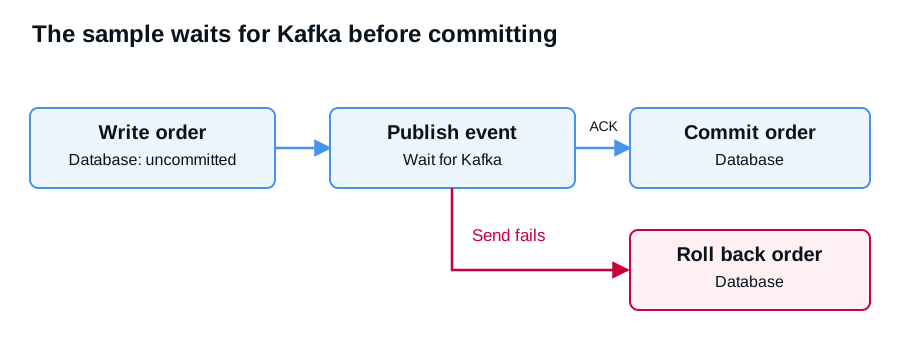
@Transactional
public Order place(String item, String status) {
    Order order = new Order();
    order.item = item;
    order.placedAt = Instant.now();
    order.status = status;
    orders.persistAndFlush(order);
    events.sendAndAwait(order.id);
    return order;
}
Here events is a MutinyEmitter<Long> for the order-events channel.
Make Kafka unavailable and check that this request fails without leaving an order behind:
int before = orderCount();
try (var ignored = faults.target(MutinyEmitter.class).unavailable()) {
    when().post("/orders").then().statusCode(503);
}
assertEquals(before, orderCount(), "failed publish rolled back the order");
when().post("/orders").then().statusCode(201);
The extension targets the emitter’s Kafka connection, including discovered brokers. Switching to fire-and-forget publishing would let the transaction commit before the send fails, breaking this test. The sample also bounds the producer’s waits so the customer is not left waiting through a prolonged outage:
mp.messaging.outgoing.order-events.max.block.ms=3000
mp.messaging.outgoing.order-events.request.timeout.ms=2000
mp.messaging.outgoing.order-events.delivery.timeout.ms=3000
There is still a gap: Kafka can accept the event and the database commit can then fail.
A lost Kafka acknowledgement can also leave the application uncertain whether the event arrived.
@Transactional does not make these two systems one transaction.
If orders must be accepted while Kafka is down, the transactional outbox changes the design: save the order and an event record in the same database transaction, then publish the event separately. That changes the test too: during the outage, assert that the order and outbox record are saved; after recovery, assert that the event reaches shipping. The relay may publish duplicates, so shipping must handle them idempotently. The sample above tests synchronous publishing; those outbox assertions would belong to an application using that design.
What else is waiting to fail?
We have checked the customer response, the stored order, and what happens when its event cannot be published. But some failures happen before a connection is established, or when the application writes a local file. You can test those failures too:
-
The customer requests an invoice, but the disk is full. Does your service report the failure and recover when space is available?
faults.directory(path).diskFull()makes supported Java file writes under that directory fail with “No space left on device”, without filling the disk. -
Inventory is healthy, but its hostname no longer resolves. Does checkout handle that failure too?
faults.target(InventoryClient.class).unresolvable()makes new connection attempts fail withUnknownHostException. Drop existing connections first so the next request encounters the fault.
The disk and DNS guide has complete tests and explains their scope. Then there are the failures that emerge as your service grows:
-
Your LLM provider says “slow down”. Does your service send even more requests? A client retry combined with
@Retrycan multiply calls. Inject a429and count the attempts that actually reach the provider. -
A stream stops after three events. Does your customer get an explanation or a broken connection? Cut it at that exact point and test the recovery path.
-
Your database pool is full. Does Kubernetes restart an otherwise healthy pod? Exhaust the pool and check whether liveness still answers.
The resilient-orders sample covers the retry and streaming scenarios; the sample catalog includes overload and health-check failures. Pick the question you are least sure how your service would answer: that is a good next test.
Make sure the test exercised the failure
A test can apply a fault to the wrong dependency and still get its expected response. The extension guards against this: if no connection goes through the target proxy while the fault is active, it fails the test and identifies the target to investigate. That guard complements your assertions; you still need to check the outcome that matters, such as one charge, a bounded wait, or recovery.
Explore it in dev mode
You can also investigate a failure before writing its regression test. Enable the Dev UI integration:
%dev.quarkus.resiliency-testing.enabled=trueThe Resiliency Testing card lets you apply faults and inspect the requests they affected. Hang inventory, place an order, and watch what the customer sees. Then turn that observation into an assertion.
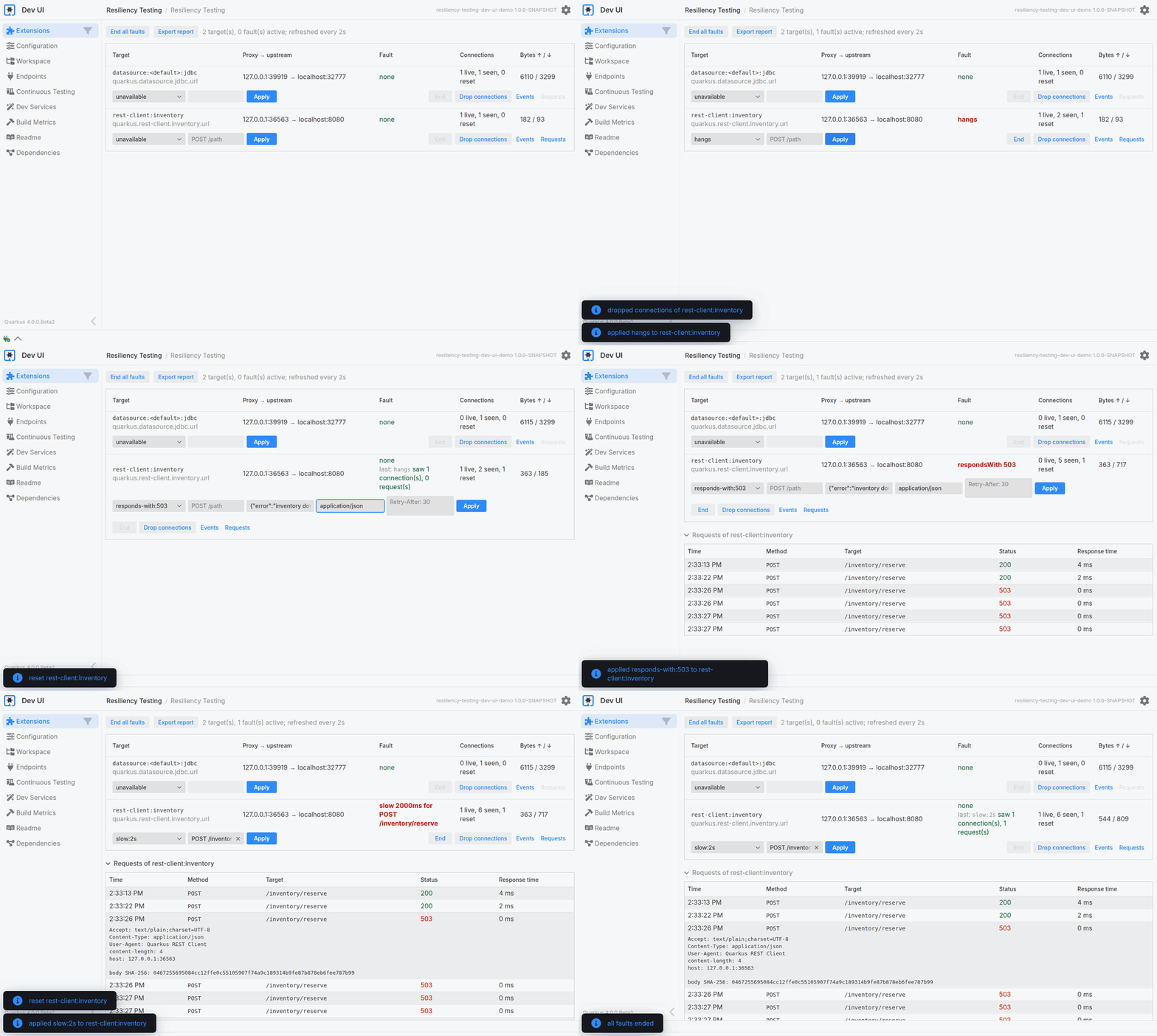
For AI-assisted test writing, the extension also exposes Dev MCP tools, a test-writing guide and an inventory of guarded methods. Fault application through these tools is opt-in in the Dev UI. The documentation covers setup and the wider API, including Redis, Kafka, LangChain4j, streaming failures and worker-pool exhaustion.
Try one failure in your service
The extension requires Quarkus 4 and Java 21. Start with one dependency and one question: if it stops answering, what should the customer see, and how soon? Apply the fault, assert that behavior, and check recovery after the block closes.
There are limits: HTTP-level faults require plaintext HTTP/1.x, connectTimeout() is Linux-only, and @QuarkusIntegrationTest is not yet supported.
See the known limitations for details, including Redis and MongoDB topology restrictions.
The complete sample includes more scenarios, from retry amplification to a database connection lost mid-transaction. If a test exposes a bug, or a failure you need is missing, tell us on GitHub or Zulip.

