# Extending configuration support
## Custom `ConfigSource`
It's possible to create a custom `ConfigSource` as specified in [MicroProfile Config](https://github.com/eclipse/microprofile-config/blob/master/spec/src/main/asciidoc/configsources.asciidoc#custom-configsources-via-configsourceprovider).
With a Custom `ConfigSource` it is possible to read additional configuration values and add them to the `Config` instance in a defined ordinal. This allows overriding values from other sources or falling back to other values.
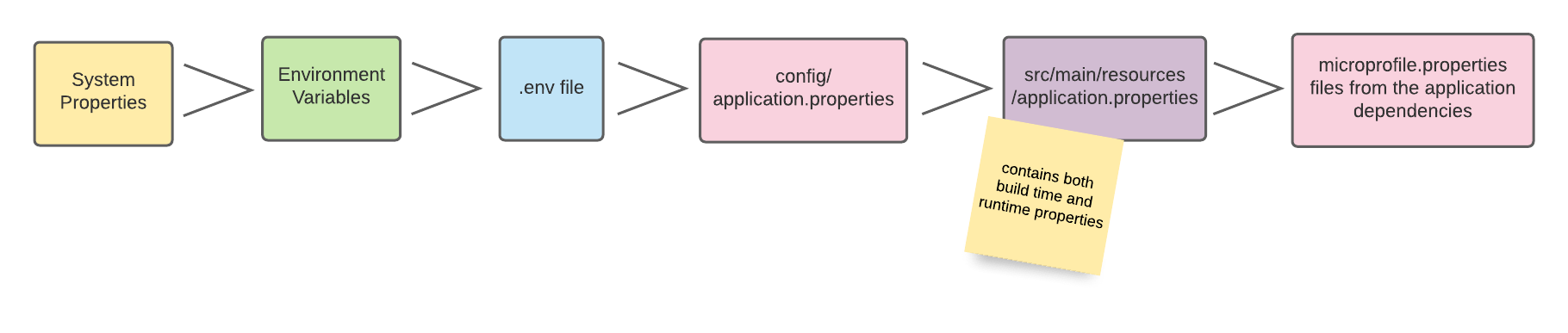
A custom `ConfigSource` requires an implementation of `org.eclipse.microprofile.config.spi.ConfigSource` or `org.eclipse.microprofile.config.spi.ConfigSourceProvider`. Each implementation requires registration via the [ServiceLoader](https://docs.oracle.com/en/java/javase/17/docs/api/java.base/java/util/ServiceLoader.html) mechanism, either in `META-INF/services/org.eclipse.microprofile.config.spi.ConfigSource` or `META-INF/services/org.eclipse.microprofile.config.spi.ConfigSourceProvider` files.
### Example
Consider a simple in-memory `ConfigSource`:
**org.acme.config.InMemoryConfigSource**
```java
package org.acme.config;
import org.eclipse.microprofile.config.spi.ConfigSource;
import java.util.HashMap;
import java.util.Map;
import java.util.Set;
public class InMemoryConfigSource implements ConfigSource {
private static final Map configuration = new HashMap<>();
static {
configuration.put("my.prop", "1234");
}
@Override
public int getOrdinal() {
return 275;
}
@Override
public Set getPropertyNames() {
return configuration.keySet();
}
@Override
public String getValue(final String propertyName) {
return configuration.get(propertyName);
}
@Override
public String getName() {
return InMemoryConfigSource.class.getSimpleName();
}
}
```
And registration in:
**META-INF/services/org.eclipse.microprofile.config.spi.ConfigSource**
```properties
org.acme.config.InMemoryConfigSource
```
The `InMemoryConfigSource` will be ordered between the `.env` source, and the `application.properties` source due to the `275` ordinal:
| ConfigSource | Ordinal |
| --- | --- |
| System Properties | 400 |
| Environment Variables from System | 300 |
| Environment Variables from `.env` file | 295 |
| InMemoryConfigSource | 275 |
| `application.properties` from `/config` | 260 |
| `application.properties` from application | 250 |
| `microprofile-config.properties` from application | 100 |
In this case, `my.prop` from `InMemoryConfigSource` will only be used if the config engine is unable to find a value in [System Properties](/guides/config-reference/index.md#system-properties), [Environment Variables from System](/guides/config-reference/index.md#environment-variables) or [Environment Variables from .env file](/guides/config-reference/index.md#env-file) in this order.
### ConfigSource Init
When a Quarkus application starts, a `ConfigSource` can be initialized twice. One time for *STATIC INIT* and a second time for *RUNTIME INIT*:
#### STATIC INIT
Quarkus starts some of its services during static initialization, and `Config` is usually one of the first things that is created. In certain situations it may not be possible to add a custom `ConfigSource`. For instance, if the `ConfigSource` requires other services, like a database access, it will not be available at this stage, and cause a chicken-egg problem. For this reason, any custom `ConfigSource` requires the annotation `@io.quarkus.runtime.configuration.StaticInitSafe` to mark the source as safe to be used at this stage.
##### Example
Consider:
**org.acme.config.InMemoryConfigSource**
```java
package org.acme.config;
import org.eclipse.microprofile.config.spi.ConfigSource;
import io.quarkus.runtime.annotations.StaticInitSafe;
@StaticInitSafe
public class InMemoryConfigSource implements ConfigSource {
}
```
And registration in:
**META-INF/services/org.eclipse.microprofile.config.spi.ConfigSource**
```properties
org.acme.config.InMemoryConfigSource
```
The `InMemoryConfigSource` will be available during *STATIC INIT*.
> [!IMPORTANT]
> A custom `ConfigSource` is not automatically added during Quarkus *STATIC INIT*. It requires to be marked with the `@io.quarkus.runtime.configuration.StaticInitSafe` annotation.
#### RUNTIME INIT
The *RUNTIME INIT* stage happens after *STATIC INIT*. In this stage a `ConfigSource` can be initialized again. There are no restrictions at this stage, and a custom source is added to the `Config` instance as expected.
## `ConfigSourceFactory`
Another way to create a `ConfigSource` is via the [SmallRye Config](https://github.com/smallrye/smallrye-config) `io.smallrye.config.ConfigSourceFactory` API. The difference between the [SmallRye Config](https://github.com/smallrye/smallrye-config) factory and the standard way to create a `ConfigSource` as specified in [MicroProfile Config](https://github.com/eclipse/microprofile-config/blob/master/spec/src/main/asciidoc/configsources.asciidoc#custom-configsources-via-configsourceprovider), is the factory ability to provide a context with access to the available configuration.
Each implementation of `io.smallrye.config.ConfigSourceFactory` requires registration via the [ServiceLoader](https://docs.oracle.com/en/java/javase/17/docs/api/java.base/java/util/ServiceLoader.html) mechanism in the `META-INF/services/io.smallrye.config.ConfigSourceFactory` file.
### Example
Consider:
**org.acme.config.URLConfigSourceFactory**
```java
package org.acme.config;
import java.util.Collections;
import java.util.OptionalInt;
import org.eclipse.microprofile.config.spi.ConfigSource;
import io.smallrye.config.ConfigSourceContext;
import io.smallrye.config.ConfigSourceFactory;
import io.smallrye.config.ConfigValue;
import io.smallrye.config.PropertiesConfigSource;
public class URLConfigSourceFactory implements ConfigSourceFactory {
@Override
public Iterable getConfigSources(final ConfigSourceContext context) {
final ConfigValue value = context.getValue("config.url");
if (value == null || value.getValue() == null) {
return Collections.emptyList();
}
try {
return Collections.singletonList(new PropertiesConfigSource(new URL(value.getValue())));
} catch (IOException e) {
throw new RuntimeException(e);
}
}
@Override
public OptionalInt getPriority() {
return OptionalInt.of(290);
}
}
```
And registration in:
**META-INF/services/io.smallrye.config.ConfigSourceFactory**
```properties
org.acme.config.URLConfigSourceFactory
```
By implementing `io.smallrye.config.ConfigSourceFactory`, a list of `ConfigSource` may be provided via the `Iterable getConfigSources(ConfigSourceContext context)` method. The `ConfigSourceFactory` may also assign a priority by overriding the method `OptionalInt getPriority()`. The priority values is used to sort multiple `io.smallrye.config.ConfigSourceFactory` (if found).
> [!IMPORTANT]
> `io.smallrye.config.ConfigSourceFactory` priority does not affect the `ConfigSource` ordinal. These are sorted independently.
When the Factory is initializing, the provided `ConfigSourceContext` may call the method `ConfigValue getValue(String name)`. This method looks up configuration names in all ``ConfigSource``s that were already initialized by the `Config` instance, including sources with lower ordinals than the ones defined in the `ConfigSourceFactory`. The `ConfigSource` list provided by a `ConfigSourceFactory` is not taken into consideration to configure other sources produced by a lower priority `ConfigSourceFactory`.
## Custom `Converter`
It is possible to create a custom `Converter` type as specified by [MicroProfile Config](https://github.com/eclipse/microprofile-config/blob/master/spec/src/main/asciidoc/converters.asciidoc#adding-custom-converters).
A custom `Converter` requires an implementation of `org.eclipse.microprofile.config.spi.Converter`. Each implementation requires registration via the [ServiceLoader](https://docs.oracle.com/en/java/javase/17/docs/api/java.base/java/util/ServiceLoader.html) mechanism in the `META-INF/services/org.eclipse.microprofile.config.spi.Converter` file. Consider:
```java
package org.acme.config;
public class MicroProfileCustomValue {
private final int number;
public MicroProfileCustomValue(int number) {
this.number = number;
}
public int getNumber() {
return number;
}
}
```
The corresponding converter will look similar to the one below.
```java
package org.acme.config;
import org.eclipse.microprofile.config.spi.Converter;
public class MicroProfileCustomValueConverter implements Converter {
@Override
public MicroProfileCustomValue convert(String value) {
return new MicroProfileCustomValue(Integer.parseInt(value));
}
}
```
> [!NOTE]
> The custom converter class must be `public`, must have a `public` constructor with no arguments, and must not be `abstract`.
The custom configuration type converts the configuration value automatically:
```java
@ConfigProperty(name = "configuration.value.name")
MicroProfileCustomValue value;
```
### Converter priority
The `jakarta.annotation.Priority` annotation overrides the `Converter` priority and change converters precedence to fine tune the execution order. By default, if no `@Priority` is specified by the `Converter`, the converter is registered with a priority of `100`. Consider:
```java
package org.acme.config;
import jakarta.annotation.Priority;
import org.eclipse.microprofile.config.spi.Converter;
@Priority(150)
public class MyCustomConverter implements Converter {
@Override
public MicroProfileCustomValue convert(String value) {
final int secretNumber;
if (value.startsFrom("OBF:")) {
secretNumber = Integer.parseInt(SecretDecoder.decode(value));
} else {
secretNumber = Integer.parseInt(value);
}
return new MicroProfileCustomValue(secretNumber);
}
}
```
Since it converts the same value type (`MicroProfileCustomValue`) and has a priority of `150`, it will be used instead of a `MicroProfileCustomValueConverter` which has a default priority of `100`.
> [!NOTE]
> All Quarkus core converters use the priority value of `200`. To override any Quarkus specific converter, the priority value should be higher than `200`.
## Config Interceptors
[SmallRye Config](https://github.com/smallrye/smallrye-config) provides an interceptor chain that hooks into the configuration values resolution. This is useful to implement features like [Profiles](/guides/config-reference/index.md#profiles), [Property Expressions](/guides/config-reference/index.md#property-expressions), or just logging to find out where the config value was loaded from.
An interceptor requires an implementation of `io.smallrye.config.ConfigSourceInterceptor`. Each implementation requires registration via the [ServiceLoader](https://docs.oracle.com/en/java/javase/17/docs/api/java.base/java/util/ServiceLoader.html) mechanism in the `META-INF/services/io.smallrye.config.ConfigSourceInterceptor` file.
The `io.smallrye.config.ConfigSourceInterceptor` is able to intercept the resolution of a configuration name with the method `ConfigValue getValue(ConfigSourceInterceptorContext context, String name)`. The `ConfigSourceInterceptorContext` is used to proceed with the interceptor chain. The chain can be short-circuited by returning an instance of `io.smallrye.config.ConfigValue`. The `ConfigValue` objects hold information about the key name, value, config source origin and ordinal.
> [!NOTE]
> The interceptor chain is applied before any conversion is performed on the configuration value.
Interceptors may also be created with an implementation of `io.smallrye.config.ConfigSourceInterceptorFactory`. Each implementation requires registration via the [ServiceLoader](https://docs.oracle.com/en/java/javase/17/docs/api/java.base/java/util/ServiceLoader.html) mechanism in the `META-INF/services/io.smallrye.config.ConfigSourceInterceptorFactory` file.
The `ConfigSourceInterceptorFactory` may initialize an interceptor with access to the current chain (so it can be used to configure the interceptor and retrieve configuration values) and set the priority.
### Example
**org.acme.config.LoggingConfigSourceInterceptor**
```java
package org.acme.config;
import static io.smallrye.config.SecretKeys.doLocked;
import jakarta.annotation.Priority;
import io.smallrye.config.ConfigSourceInterceptor;
import io.smallrye.config.ConfigLogging;
@Priority(Priorities.LIBRARY + 200)
public class LoggingConfigSourceInterceptor implements ConfigSourceInterceptor {
private static final long serialVersionUID = 367246512037404779L;
@Override
public ConfigValue getValue(final ConfigSourceInterceptorContext context, final String name) {
ConfigValue configValue = doLocked(() -> context.proceed(name));
if (configValue != null) {
ConfigLogging.log.lookup(configValue.getName(), configValue.getLocation(), configValue.getValue());
} else {
ConfigLogging.log.notFound(name);
}
return configValue;
}
}
```
And registration in:
**META-INF/services/io.smallrye.config.ConfigSourceInterceptor**
```properties
org.acme.config.LoggingConfigSourceInterceptor
```
The `LoggingConfigSourceInterceptor` logs looks up configuration names in the provided logging platform. The log information includes config name and value, the config source origin and location if exists.